

CLICK HERE for the table of contents and links to full text. Alternatives to the Anthropocene This issue of Radical History Review examines the heterogeneous imaginaries and social movements struggling against the social and environmental destruction of the Anthropocene, the notion of a homogenous humanity driving the geological era of climate change. Features Matthew Shutzer and Arpitah Kodiveri examine extractive economies and the origins of subterranean sovereignty in the colonization of the Indian subcontinent. Adam Quinn offers a transnational intellectual history of anarchist environmentalist politics in the late 19th and early 20th centuries. Christian Høgsbjerg traces a thread of environmental […]
Admin
43 posts

CLICK HERE for the table of contents and links to full text. This issue of Radical History Review interrogates and reimagines the “Afropolitan,” the term coined by writer Taiye Selasi and popularized by theorist Achille Mbembe. Our contributors creatively reframe the Afropolitan as part of a broader history of global networks, pasts, and futures. Feature Essays Elizabeth Fretwell examines and contextualizes the Afropolitanism of elite sartorial culture of precolonial Dahomey. Ndubueze Mbah theorizes the “rebellious mobilities” of nineteenth-century Liberated Africans who returned to Nigeria from Sierra Leone. Reflections on the Afropolitan Antonia Carcelén-Estrada uses gendered absences in Sánchez-Gallque’s iconic Los […]

After the Economic Miracle Issue number 151 (January 2025) Abstract Deadline: May 1, 2023 Co-Edited by Ravinder Kaur and Barbara Weinstein To witness the world through the many unfolding “economic miracles” is to behold dreamworlds and catastrophes all at once. Initially tied to the post-war phenomenon of wirtschaftswunder – the dramatic pace of economic recovery in West Germany – the seductive idea of “economic miracle” captured the imagination of policymakers especially across the old third world. From the “miracle on the Han river” in South Korea, the “East Asian miracle,” the South East Asian “tiger economies” to the “Chilean miracle” […]

CLICK HERE for the table of contents and links to full text. This issue challenges pre-existing conceptions about Irish historiography and where we situate Ireland within the global order. The issue thus provides new roadmaps for how we write the history of Ireland. Empire and After José Brownrigg Gleason identifies linkages between national liberation in Ireland and Latin America. Kenneth Shonk studies how African nationalists looked to post-1922 Ireland as a model of postcolonial state-building. Kerron Ó Luain analyzes Irish-language activism in the 1970s as a subaltern phenomenon. Aidan Beatty explores the unwillingness of Stuart Hall and the British New […]

Revolutionary Papers: Counter-Institutions, -Politics and -Cultures of Anticolonial Periodicals in the Global South Issue number 150 (October 2024) Abstract Deadline: August 15, 2022 Co-Edited by Mahvish Ahmad, Chana Morgenstern, Koni Benson, and Alex Lichtenstein Radical History Review seeks contribution for a special issue entitled Revolutionary Papers. This issue will examine periodicals and other print ephemera—including newspapers, cultural and literary journals, magazines, and pamphlets—as sites of Left, anti-imperial, and anti-colonial critical production across the Global South. During struggles against colonialism, Apartheid, and postcolonial violence, revolutionary papers generated oppositional networks, critical politics, left mobilizations, literary scenes, and alternative artistic practices. Often produced […]

CLICK HERE for the table of contents and links to full text. This issue of Radical History Review examines impacts of the visual to pose new questions and challenges for scholars of sex. Roundtable Curators speak openly about sexuality, queer and trans experience, and the challenge of showcasing sexual histories to broad publics in museum and gallery spaces. Featured Essays Sunny Xiang’s analysis of swimsuit ads and synthetics shows how the white, female “bikini blonde” functioned as iterations of “atomic culture.” Lynda Nead pieces together photography and self-presentation in the life of Ruth Ellis, the last woman hanged in Britain […]

CLICK HERE for the table of contents and links to full text. This issue of Radical History Review examines the immediacy of how “breaking news” enters into the machinations of interpretation, circulation, and canonization, while considering how the positionalities of the producers, audiences, and contexts affect the interpretation of political events, activist issues, and “official knowledge.” Regulating the News AJ Bauer explores the origins of the Fairness Doctrine of 1949. Sarah Nelson investigates the Global South’s advocacy for an international telecom system to foster information sovereignty. Allison Perlman analyzes the creation of Intertel as a way to reconfigure the role […]

CLICK HERE for the table of contents and links to full text. This issue of Radical History Review traces histories from around the globe and examines how HIV/AIDS has been shaped by the political economies of neoliberalism and state violence. Teaching Radical History Robert Franco illustrates how to teach a global history of AIDS. Features Laura Frances Goffman examines the temporality of AIDS in Kuwait. Joseph Hower analyzes how the public sector union AFSCME moved from anti-discrimination to carceral unionism in responding to AIDS. Salonee Bhaman illustrates the contradictions of housing advocacy for people with HIV/AIDS in 1980s New York […]

CLICK HERE for the table of contents and links to full text. This issue of Radical History Review examines the histories and politics of old age, highlighting approaches that denaturalize chronological age and normative models of the life course by centering power, historical struggle, and linked lives. Conversations Stephen Katz, Kavita Sivaramakrishnan, and Pat Thane discuss the past and potential of critical aging studies and consider its lessons for the age of COVID-19. Slavery, Emancipation, and the Politics of Elder Care Corinne T. Field considers Sojourner Truth, Harriet Tubman, and their black feminist calls for old age justice. Henrique Espada […]

CLICK HERE for the table of contents and links to full text. This issue of the Radical History Review offers histories of fascism and antifascism after 1945 to interrogate the ways that fascist ideology continues to circulate and be opposed transnationally despite its supposed death at the end of the Second World War. Features Antonino Scalia integrates anti-imperialism into the conversation about antifascism through an analysis of Italian Communist internationalism in the 1960s while Michael Staudenmaier explores the use of fascism in the construction of the Latino/a/x Left in the 1970s. Rosa Hamilton turns to the London Gay Liberation Front […]
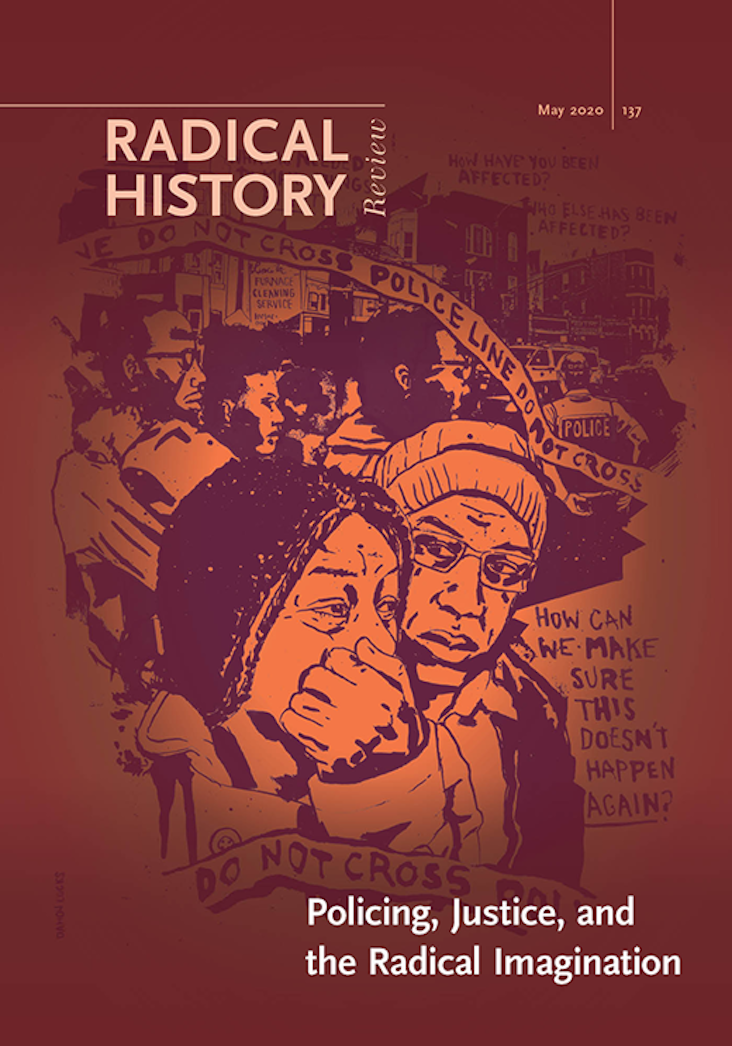
CLICK HERE for the table of contents and links to full text. This issue collects scholarship and activist work that challenges the assumption that police are necessary by examining instances of social peace without formal, institutionalized police. Features Tom Lambert reconstructs how local communities in tenth-century England carried out legal interdictions while tempering violent retributive justice. Luke A. Fidler considers how public sculpture imposed order by displaying scenes of punitive captivity in the medieval Anglo-Saxon world. Gagan Preet Singh examines why victims of cattle-theft in colonial north India avoided the police, relying instead on communal justice. Alex Winder investigates the […]

CLICK HERE for the table of contents and links to full text. This issue of Radical History Review reflects on the legacy of the Cuban Revolution as it reaches its sixtieth anniversary. Exploring the transnational meanings of the revolution through the lens of sexuality and gender, these essays offer fresh insight into Cuba’s global impact on politics and culture during the Cold War and beyond. Internationalism and Solidarity Sarah J. Seidman explores Angela Davis’s encounters with the Cuban Revolution. Lorraine Bayard de Volo analyzes the race and gender politics of Cuba’s mission in Angola. Emily Snyder traces ideas of love […]